|
|
|
|
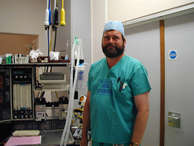
Dr
Andrew Jones, Consultant Anaesthetist

Dr
Austin Leach, Consultant Anaesthetist
|
|
Anaesthetist
The anaesthetist is a medically qualified doctor specializing in anaesthesia,
which literally means the prevention of pain.
Anaesthesia is
either general, with you being put to sleep during the operation, or
local, with anaesthetics being injected around the eye.
Our two main anaesthetists
are Dr Andrew Jones and Dr Austin Leach.
Dr Andrew Jones,
BSc, MBBS, DGM, FRCA, is currently clinical director of anaesthesia.
He qualified at St Bartholomew's Hospital in 1982 and has been working
in the ocular oncology Centre since 1994.
Dr Austin Leach,
MBBS FRCA, qualified at St Thomas's Hospital in 1982 and has worked
with our Centre since 1993.
|
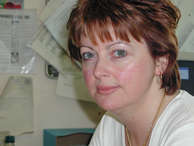 Miss
Jane Kelly, Business Administrator
Miss
Jane Kelly, Business Administrator
|
|
Business Administrator
The business administrator is very much like a general manager of a
firm, responsible for the day to day affairs of the organization.
Miss Jane Kelly
has held this post since 1992 and played a major role in the relocation
of St Paul's Eye Unit from Old Hall Street to the Royal Liverpool University
Hospital. She has also contributed greatly to the establishment of the
ocular oncology centre.
|
| |
|
Her main duties
are:
- Communicating
with the Department of Health regarding all administrative aspects of
the Centre;
- Liaising with
the ocular oncologist on all financial matters related to the development
of the oncology centre;
- Organizing the
purchase of equipment;
- Organizing systems
for accommodating patients and relatives, providing interpreters, and
handling private fees.
|
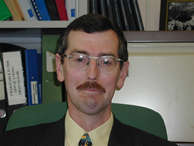 Dr
Jim McGalliard, Clinical Director and Consultant Vitreoretinal surgeon
Dr
Jim McGalliard, Clinical Director and Consultant Vitreoretinal surgeon |
|
Clinical director
The clinical director is responsible for the running of St Paul's Eye
Unit. He or she is normally appointed from the consultant team for a
period of three years.
The current clinical
director is Mr Jim McGalliard, who is a consultant ophthalmologist specializing
in retinal surgery.
|
| |
|
Consultant ocular
oncologist
The consultant ocular oncologist is an ophthalmologist specializing
in the diagnosis and treatment of ocular tumours. Our consultant ocular
oncologist is Mr Bertil Damato, PhD FRCS FRCOphth. He did his undergraduate
training in Malta and came to Britain in 1977. He did his postgraduate
training in Glasgow. He specialized in ophthalmology since 1980 and
has worked in ocular oncology since 1984. In 1993, he established the
Liverpool Ocular Oncology Centre.
|
 Mr
Gary Cheetham, Data Manager
Mr
Gary Cheetham, Data Manager |
|
Data manager
The data manager ensures that our ocular oncology database is complete,
correct and up-to-date. Our data manager is Mr Gary Cheetham, who has
worked in our oncology Centre since 1997.
The duties of the
data manager include:
- Checking the notes
every time a patient is seen, to ensure that there are no errors in
the database;
- Computerizing
data returned by referring ophthalmologists and in questionnaires;
- Computerizing
information received from the National Cancer Registry regarding any
deaths;
- Retrieving the
NHS number of each new patient from the general practitioner or the
referring health authority;
- Performing various
studies, such as the quarterly review of activity;
- Providing assistance
when our usual oncology secretary is absent.
|
| |
|
Medical oncologist
The medical oncologist is a doctor specializing in the treatment of
cancer by chemotherapy or immunotherapy.
We collaborate
with several medical oncologists at Clatterbridge Centre for Oncology.
Nurse
The primary route to obtaining a nursing qualification in England is
the Diploma of Higher Education in Nursing. This is of three years duration.
Graduates holding
a health-related degree can follow an accelerated diploma programme.
Nurses wishing
to work in ophthalmology need to complete a course in ophthalmic nursing,
which is a part-time, modular course lasting 42 weeks.
Ophthalmic nurses
can also obtain a specialist ophthalmic practitioner qualification,
leading to a BA (Hons) in health care practice.
|
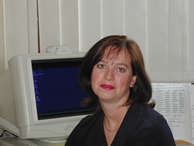 Mrs
Julie Sudlow, Ocular Oncology Secretary
Mrs
Julie Sudlow, Ocular Oncology Secretary |
|
Ocular oncology
secretary
The ocular oncology secretary is responsible for all administrative
matters related to our Centre. Our secretary is Mrs Julie Sudlow, who
has worked with our oncology Centre since 1994.
|
| |
|
The duties involve:
- Handling all correspondence;
- Typing and filing
all letters;
- Organizing clinics
and admissions;
- Arranging accommodation
for patients and relatives;
- Organizing an
interpreter, if required for an overseas patient;
- Preparing operating
theatre lists;
- Organizing fax
and telephone communications between our Centre and radiotherapists
at the Clatterbridge Centre for Oncology;
- Preparing and
circulating questionnaires.
|
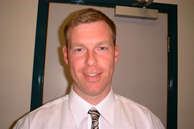 Mr
Ronnie Jackson, Senior Ophthalmic Photographer
Mr
Ronnie Jackson, Senior Ophthalmic Photographer |
|
Photographer
Ophthalmic photographers specialize in taking colour photographs and
angiograms of the eye, using special equipment. The ophthalmic photography
unit is headed by Mr Ronnie Jackson.
|
| |
|
Pathologist
The pathologist is a doctor specializing in pathology, which is the
study of disease. This involves:
Measuring and describing
all specimens, both macroscopically (ie, using the naked eye) and with
a microscope;
- Providing a diagnosis;
- Reporting tumour
characteristics that are of prognostic value;
- Preparing a dictated
report, for filing in the casenotes, a copy of which is routinely sent
to the referring ophthalmologist;
- Completing a proforma,
for computerization of relevant data;
- Organizing a clinico-pathological
conference each Monday afternoon, so that all tumour specimens can be
discussed in detail with the surgeons;
- Participating
in teaching and research.
There are two pathologists
currently working with our oncology Centre.
Dr Paul Hiscott,
MBBS, PhD, FRCS(Glas), FRCOphth, FRCPath is a Senior Lecturer in Ophthalmic
Pathology. He qualified in London in 1977 and has worked with the ocular
oncology Centre since 1996. He is Honorary Secretary of the European
Ophthalmic Pathology Society and a Member of the UK Intercollegiate
Working Group on ophthalmic pathology.
Dr Peter Smith
qualified in London in 1976. He has worked at the Royal Liverpool University
Hospital since 1985 and has collaborated with our Centre since 1993.
Dr Smith has special expertise in cytology, which is the study of cell
structure, and is the chairman of the British Society for Clinical Cytology.
Radiologist
The radiologist is a doctor specializing in body imaging, that is, x-rays,
magnetic resonance imaging, and computerized tomography.
|
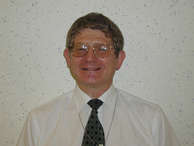 Dr
R D Errington, Consultant Radiotherapist/Oncologist
Dr
R D Errington, Consultant Radiotherapist/Oncologist |
|
Radiotherapist
The radiotherapist is a doctor specializing in radiotherapy, which is
the treatment of tumours with radiation.
Our radiotherapist
is Dr Doug Errington, who qualified at St Mary's Hospital in London
in 1973. He has worked with our Centre since 1993. Dr Errington has
special expertise in the radiotherapy of ocular disease and has assisted
in the development of the proton beam facility at the Douglas Cyclotron
Centre. He is also a clinical oncologist.
|
| |
|
Senior house
officer
The senior house officer (SHO) is a doctor, usually of two or three
years standing, who has recently entered a specialty.
Senior house officers
in ophthalmology work in the ocular oncology Centre for about six or
eight weeks. Their duties involve:
- Examining patients
on admission to hospital and preparing patients for surgery;
- Organizing any
relevant tests and retrieving the results;
- Assisting at theatre
and in the clinics;
- Contributing to
patient care in the ward.
|
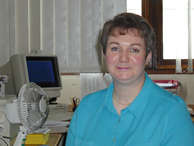 Sister
Jane Humphreys, Specialist Ocular Oncology Nurse
Sister
Jane Humphreys, Specialist Ocular Oncology Nurse |
|
Specialist ocular
oncology nurse
The specialist ocular oncology nurse is an ophthalmic nurse who dedicates
the whole of her time to the care of patients with ocular tumours. Sister
Jane Humphreys BA RGN OND obtained her ophthalmic nursing diploma in
1983.
|
| |
|
After completing
her registration in 1986 she worked first as an ophthalmic nurse and
then in the operating theatre, becoming a senior theatre sister. She
then joined the ocular oncology centre as a clinical nurse specialist,
initially as a research nurse and latterly as a specialist ocular oncology
nurse.
|
| |
|
The duties involve:
- Counselling patients
in the clinic and the ward;
- Providing a telephone
help-line service;
- Assisting with
patient satisfaction studies and other projects;
- Assisting the
consultant at clinics and in the operating theatre.
Specialist ophthalmic
registrar
The specialist ophthalmic registrar (SpR) is a medical doctor in the
process of being trained as an ophthalmologist. This period of training
lasts about four and a half years. At the end of this training, an SpR
needs to pass an exit examination to be able to compete for a post as
consultant ophthalmologist. Specialist registrars rotate through all
sub-specialties in ophthalmology, including ocular oncology, spending
between three and six months in each firm.
Vitreoretinal
surgeon
The vitreoretinal surgeon is a consultant ophthalmologist who specializes
in the surgical treatment of retinal disorders. Patients developing
retinal complications after local resection or endoresection benefit
greatly from the expertise of such specialists.


|