We have a full time
data manager, who ensures that the database is correct and complete.
We have introduced a structured questionnaire for routinely eliciting
and recording all ocular symptoms of all patients at every follow-up
clinic.
We have also developed
a system for recording accidents as well as 'near-misses', so that complications
can be prevented.
We have recently
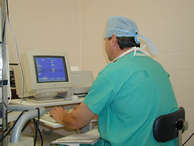
installed a computer terminal in our operating theatre so that we can
computerize all important information, including complications, at the
end of each operation.
The audit results
are reviewed as soon as they become available.
Appropriate action
is taken after discussions are held amongst members of our Centre. For
example, when a survey revealed that referring ophthalmologists felt
that they had waited too long for our report after the patient's discharge
from hospital, discharge letters were written at the end off the operation
instead of when the patient was discharged.
The Department
of Health has published standards, which must be met by cancer care
providers in all specialties and we assess our own results in terms
of those standards.
In addition, we
provide our funding authority, NSCAG, with our own results upon request
so that they can assess our performance. Generally, we seem to be setting
our own standards because data on the performance of other ocular oncology
centres are not available.