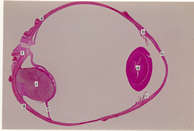
Anterior chamber.
The cavity in the eye lying in front of the iris and lens.
Anterior chamber
angle
The margin of the anterior chamber, where the cornea meets the iris.
This is where the 'trabecular meshwork' (ie, gutter) drains water from
the eye. Closure of the angle, for example, by tumour, causes glaucoma,
which may be painful.
Benign.
The tendency for a tumour to show slow and limited growth without breaking
surrounding barriers and without seeding to other parts of the body.
Cancer.
A group of diseases characterized by the formation of a neoplastic tumour
having the capacity to invade surrounding tissues and colonize distant
parts of the body.
Cell.
The fundamental 'building block' of the human body.
Choroid.
A vascular and deeply pigmented tissue lining, which is sandwiched
between the retina and the sclera. The choroid is shaped like a semi-circular
cup or bowl.
Ciliary body.
A ring of tissue lying at the rim of the choroid and comprising the
pars plicata, which is corrugated, and the pars plana, which is flat.
The parts plicata pumps water into the eye and supports the lens.
Conjunctiva.
A transparent membrane loosely covering the white of the eye and lining
the inner surface of the eyelids.
Cornea.
The transparent 'window' of the eye, through which the coloured iris
and the black pupil are visible.
Cytogenetic studies
These studies examine the chromosomes (ie, the DNA) inside the tumour
cells so as to identify abnormalities known to be related to the prognosis
for survival. For example, loss of chromosome 3 from melanoma cells
is associated with a reduced chance of surviving five years.
Fornix
The fold where the eye meets the eyelid.
Fovea
The central part of the retina, which provides detailed vision for recognizing
faces, reading, watching TV, etc.
Glaucoma
Excessive intraocular pressure on the optic nerve, causing visible damage
to the nerve and visual loss, which may occur with or without pain.
Haemangioma
A benign tumour consisting of blood vessels, similar to a 'stork mark'
on the skin.
Iris.
The coloured curtain regulating the amount of light entering the eye.
Lens.
The transparent structure lying immediately behind the pupil, which
focuses the image upon the retina.
Lymphatic system
A system
of fine tubes conducting milky fluid (ie, lymph) from the tissues first
to nearby lymph nodes (ie, 'glands') and then to the major veins, near
the heart.
Malignant.
The tendency for a tumour to behave in an aggressive fashion, growing
to a large size, breaking barriers to invade surrounding tissues, and
disseminating seeds to other parts of the body to form metastatic tumours.
Metastatic disease.
Disease occurring when tumour cells travel through the blood or lymphatic
circulation to form colonies at sites distant from the primary lesion.
Neoplasm.
A tumour composed of an abnormal family of cells, which may behave in
a benign or malignant fashion.
Ocular.
Pertaining to the eyeball and its covering membrane, the conjunctiva.
Oncologist.
A medical doctor specializing in the treatment of cancer.
Oncology.
The investigation and treatment of cancer.
Ophthalmologist.
A medical doctor specializing in ophthalmology.
Ophthalmology.
The investigation and treatment of diseases of the eye and surrounding
structures.
Optic nerve.
The nerve connecting the eye to the brain.
Orbit.
The bony cavity, padded with fat, which contains the eye, the ocular
muscles, and any related blood vessels and nerves.
Posterior chamber.
The cavity within the eye lying behind the iris.
Pupil.
The central opening in the iris, through which light passes to reach
the retina and through which aqueous flows from the posterior chamber
to the anterior chamber of the eye.
Retina.
The light-sensitive film lying at the back of the eye.
Sclera.
The leathery, white bag forming the eyeball and containing all the intraocular
structures. The sclera is shaped like a cup, which is closed by the
transparent cornea at the front of the eye.
Tumour.
A mass or lump, ,which may consist of blood clot, neoplastic cells,
a cyst.
Vitreous gel
This is the clear jelly filling the posterior chamber of the eye.
Zonule.
A fine net basket containing the lens.