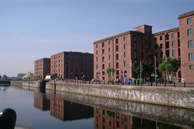
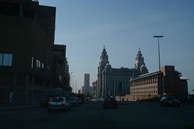
Albert Dock
In the late 19th century, this was the gateway to the United States.
It fell into disuse and was recently restored into a complex of shops,
restaurants, and museums.
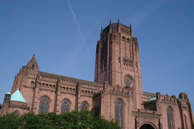
Anglican Cathedral
A magnificent gothic cathedral started in 1904 and completed in 1978.
Designed by Sir Giles Gilbert Scott, who also designed the old, red
telephone box. This is the largest cathedral in Britain and has the
largest organ in the world. Be sure to walk behind the alter and visit
the Lady Chapel. The café is very popular with locals.
Beatles Tour
A bus tour of places related to the famous pop group, the Beatles, provides
a good way of seeing the city.
Chester
This is a beautiful walled city, with the famous medieval and Victorian,
two-tier shopping arcades and the cathedral. About an hour away from
Liverpool, conveniently reached by train or car.
Geography
Virtually at the geographic centre of the British Isles, on the North
West coast of Britain, north of the Mersey estuary in the county of
Merseyside.
Located 351 miles
from Aberdeen, 103 miles from Birmingham, 184 miles from Bristol, 169
miles from Cardiff, 120 miles from Coventry, 282 miles from Dundee,
223 miles from Edinburgh, 225 miles from Glasgow, 77 miles from Leeds,
122 miles from Leicester, 220 miles from London, 36 miles from Manchester,
169 miles from Newcastle, 110 miles from Nottingham, 255 miles from
Portsmouth, 237 miles from Southampton, and 171 miles from Swansey,
History
Liverpool flourished in the 17th and 18th centuries when trade in sugar,
cotton and slaves was at its peak. In the 19th century, it was the main
port for emigrants to the United States of America. Shipbuilding also
developed. Liverpool declined when a large canal was built connecting
Manchester to the sea. It was severely bombed during the Second World
War. When the two Mersey tunnels were built, in 1934 and 1971 respectively,
many people moved to live on the Wirral peninsula.
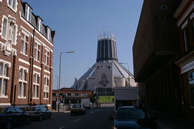
Metropolitan
cathedral
This is a modern Roman Catholic cathedral, with a marble alter
at the centre of a large circular nave, from which 13 small chapels
radiate. The stained glass windows are impressive.
Philharmonic
Hall
Home of the famous Liverpool Philharmonic Orchestra. It was built
in the mid 19th century, rebuilt after a fire in 1933 and extensively
restored a few years ago. The Philarmonic pub across the street is quite
spectacular.
Population of
Liverpool
497,000
Port Sunlight
Located on the Wirral peninsula, this is a beautiful, 130 acre,
Victorian garden village built by William Hesketh Lever in 1888 for
the workers of his soap factory. It contains the Lady Lever Art Gallery,
with its outstanding collection of paintings, statues and furniture.
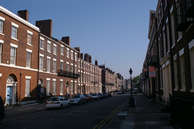
Rodney Street
A fine
street lined by Georgian houses, including the birthplace of William
Gladstone, a former prime minister. The 'Harley Street' of Liverpool,
with several private clinics.
Royal Liver Building
This famous landmark by the sea has twin towers topped by statues
of Liver Birds, from which the city is said to have taken its name.
This building also has Britain's largest clock.
Speke Hall
A beautiful half-timbered building, one of the best preserved in
Britain, built between 1490 and 1612.
St George's Hall
This is an imposing Greco-Roman building on Lime Street, finished
in 1854.
Tate Gallery
This is located in the Albert Dock and houses a part of the National
Collection of 20th Century Art.
Walker Art Gallery
This houses a collection of famous paintings, including works by
Rembrandt, Rubens, and George Stubbs, who was born in Liverpool in 1726.