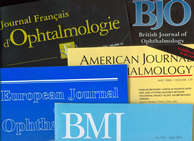
The consultant ocular oncologist, at his own expense, subscribes to
all the major ophthalmic journals, which are delivered to his home for
him to read and add to his personal library.
He also has most
of the main textbooks on ophthalmology, which he has purchased or which
have been given to him by the authors, who he knows personally, or by
the publishers, because he has written a chapter.
Once a month, the
consultant scans the United States National Library of Medicine's Pubmed
index on the internet and if there are any abstracts that seem interesting
he saves that abstract on his computer, using a special database. If
it seems worthwhile reading the entire article, he sends a fax to the
librarian of the Liverpool Medical Institution, who obtains a copy of
the article, if necessary from another library.
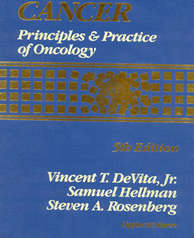
The consultant also
ensures that he has the latest edition of a major textbook on oncology,
so that he can keep abreast of developments in other fields of medicine
and science.
The consultant finds
attendance at scientific conferences to be an effective method of learning,
not only because he can obtain information before it has even been published
in the journals but also because he meets the researchers themselves
and can discuss matters privately, perhaps over a cup of coffee.
Case reports and
anecdotes are particularly instructive because they enable the consultant
ocular oncologist to be prepared to deal with any rare condition he
may not have encountered previously.