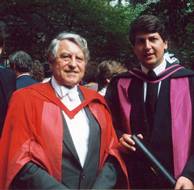
Professor W S Foulds CBE
and
Mr Bertil Damato (1987)


The Ocular Oncology Centre

The Ocular Oncology Centre at the Royal Liverpool University Hospital was established in January 1993.

Mr Damato became interested in ocular oncology in 1980, when he started working at the Tennent Institute of Ophthalmology in Glasgow under the leadership of Professor Wallace Foulds, whose pioneering surgery for ocular tumours had received world-wide acclaim.

In 1984, Professor Foulds was granted special funding from the Scottish Home and Health Department to establish an Ocular Oncology Service in Glasgow and he invited Mr Damato to join him in this work.

In 1989, Professor Foulds retired and Mr Damato continued to run the oncology service.

In 1993, Mr Damato moved to Liverpool because it was more accessible to most patients, being located at the geographic centre of the British Isles. Liverpool was also a suitable choice because of its close proximity to the Clatterbridge Centre for Oncology, which is the only centre in Britain with facilities for proton beam radiotherapy of ocular tumours.

The Liverpool Ocular Oncology Centre grew rapidly, with the number of new patients reaching almost 450 in 1999 alone.

The Liverpool Ocular Oncology Centre has developed considerably over the years and the team now includes an Oncology Secretary, a Specialist Ocular Oncology Nurse, a Data Manager, and a Lecturer in Ocular Tumour Biology. Close collaborative links have been established with Pathologists, Radiotherapists, Oncologists, and Radiologists so as to provide a comprehensive service.

In 1997, the Ocular Oncology Centre was designated a 'Supra-Regional Service' by the National Specialist Commissioning Advisory Group (ie, 'NSCAG') at the Department of Health in London. The purpose of this organization is to ensure that patients with rare conditions, such as such as ocular tumours, are given the highest possible standard of care by an experienced specialist team.

The Liverpool Ocular Oncology Centre offers an exceptionally wide range of treatments, which include:

  • Plaque radiotherapy, placing a saucer-shaped applicator behind the eye for 3-7 days;
  • Proton beam radiotherapy, directing a highly focused beam at the tumour using special equipment, located at Clatterbridge Centre for Oncology, on the Wirral Peninsula;
  • Trans-scleral local resection, removing the tumour through a large trap-door created in the wall of the eye;
  • Trans-retinal local resection, 'hoovering' the tumour through a hole in the retina;
  • Trans-pupillary thermotherapy; sterilizing the tumour with a beam of infra-red laser; and
  • Enucleation, removing the eye, which is the last resort, when other methods are unlikely to conserve the eye with useful vision.

This wide choice enables us to design the optimal treatment strategy for each patient, if necessary combining different methods so as to achieve the best possible results.

Facilities for special investigations include:

  • Colour photography, for documenting tumour appearances;
  • Fluorescein angiography, for investigating tumour circulation;
  • Ocular ultrasonography; for measuring tumour dimensions and tissue consistency;
  • Tumour biopsy, performed either using a fine needle, or through a small trapdoor in the eye wall;
  • Computerized tomography, for producing fine x-ray images of the eye;
  • Magnetic resonance imaging, producing fine images of the eye with added information on tissue type.

We believe it is important for patients to know as much as possible about their condition and its treatment and have instituted several protocols to enhance communication:

  • Giving patients a series of guides and information leaflets;
  • Giving all new patients an audio-cassette tape recording of their consultation;
  • Publishing an annual newsletter;
  • Creating a website on the internet;
  • Providing a telephone helpline, run by our Specialist Ocular Oncology Nurse.

To maintain high standards we also:

  • Prepare staff guidelines;
  • Conduct patient satisfaction surveys;
  • Measure satisfaction of referring ophthalmologists;
  • Conduct research;
  • Encourage complaints;
  • Perform continuous outcomes assessments (ie, Audit).