These tests are
performed mainly to ensure that you are fit for general anaesthesia.
If there is an
increased probability of tumour spread to the liver, because of large
tumour size, abnormal liver function tests, or a palpable liver on clinical
examination, then liver ultrasonography will be organized.
We do not perform
a liver scan on all patients routinely because in most patients the
chances of finding tumour spread are very small and much less than finding
harmless abnormalities, such as cysts.
When a scan is ordered,
we try to obtain the result before treatment is started. However, we
do not cancel or postpone surgery even if we are unable to obtain the
scan results in time.
Admission to
Ward
Once you
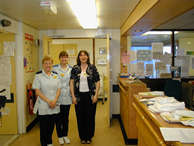
have completed your examination, you will be admitted to Ward 8X. A
nurse will welcome you and show you to your bed. You will be asked more
questions about your general health, medications, allergies, and other
matters.
A named ophthalmic
nurse will be allocated to your care, to look after your individual
needs. All nurses and doctors wear name badges at all times.
Ward 8x is divided
into several rooms, with each multi-bed room housing patients of the
same sex. There are a few single rooms for patients requiring isolation.
You will be visited
by our specialist ocular oncology nurse, who will see how your are settling
into the hospital and who will answer any questions you may have. If
you are to have a local resection or enucleation for melanoma, you will
be asked whether you would like to be informed of the results of cytogenetic
studies, and, if so, how you should be informed (that is, by means of
a letter or telephone call). Cytogenetic studies of tumour cells are
performed in the laboratory so as to give an indication of the chances
of survival after treatment of ocular melanoma.
The Senior House
Officer (SHO) will perform a full clinical examination and will prescribe
any of your usual medications that you need to continue taking during
your stay in hospital.
You will be asked
to sign a consent form, which specifies the nature of the operation
and the eye to be treated.
If the operation
involves removal of the tumour or the eye, then you will be asked for
permission to use a small tumour specimen and two blood samples for
research purposes. You are of course under no obligation to participate
in any studies.
This is another
opportunity for you to ask any more questions that come to mind. At
the appropriate time, you will be shown how to instill eye drops.
As soon as possible,
the SHO will obtain the results of all investigations, ensuring that
these are adequately documented in your casesheet.
The anaesthetist
will visit you by your bedside on the afternoon before your operation.
The aims of this visit are to ensure that you are fit for anaesthesia
and to explain to you the details of your anaesthetic. The results of
your ECG and any other relevant investigations will be reviewed. You
will be asked about any previous anaesthetics you have received. Please
feel free to ask any questions in return.
Once you have seen
the anaesthetist you can leave the hospital for a few hours, if you
wish. Before you do so, however, please be sure to inform the nursing
staff and to agree upon a time when you should return.
Visiting time is
between 2.00 pm and 8.00 pm, although special arrangements for visiting
at other times can be made with the nursing staff.
Pre-operative
Ward Round
On the day of your operation, you will be visited by an Ophthalmologist
to check any details and to ensure that all is well.
If you are to have
a general anaesthetic, you will need to fast for at least six hours
beforehand, that is, from midnight if your operation is scheduled in
the morning and from about 7 am if you are due to have your operation
in the afternoon. While fasting, you must have nothing at all to eat
or drink.
If the tumour is
at the back of the eye, we will dilate the pupil of the eye to be operated
upon.
Transfer to
operating theatre
About an hour before your operation, you will be taken in your bed to
the operating theatre suite, which is on the ground floor. There will
be two porters pushing the bed and a nurse to accompany you.
On arrival at the
theatre suite, you will be welcomed by a theatre nurse, who will check
certain details and keep you company until it is time for your operation.
The anaesthetic
room
When it is time for your operation, you will be moved to the anaesthetic
room and transferred from your bed to the operating table.
The operating department
assistant (ODA) will attach electrical leads to your chest and arms
to monitor your heart. If local resection is to be performed, additional
leads will be attached to your head for brain monitoring. All leads
are attached to the skin with adhesive tape.
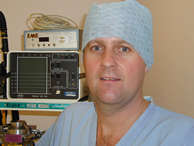
The anaesthetist
will put you to sleep by giving you an injection on the back of your
hand.
Once you are anaesthetized,
the anaesthetist will maintain your airway by placing either a larygneal
tube or mask at the back of your throat. This is to ensure that you
have no difficulty breathing during the operation.
If the eye is to
be removed, a mixture of local anaesthetic with adrenaline solution
is injected behind the eye to reduce bleeding and post-operative pain.
The operating
theatre
The electrical leads and a breathing tube will be linked up to the anaesthetic
machine so that your pulse, blood pressure, oxygen level and your heart
will be monitored continuously.
If you are to receive
hypotensive anaesthesia, which is necessary for local resection of the
tumour (ie, 'trapdoor operation'), then your brain activity will be
monitored continuously. All of these precautions ensure that there is
a healthy exchange of fresh air through your lungs and a healthy circulation
of blood throughout your body while you are under anaesthesia.
The anaesthetist
will stay with you throughout the operation.
Your identity will
be confirmed by a nurse, by checking your wrist band and the signed
consent form, which will also be used to check that the correct type
of operation is to be performed.
If you are to have
a local resection, then the lashes are trimmed (These re-grow back to
normal in six weeks).
The skin around
the eye to be operated is cleaned with an antiseptic solution called
Betadine, which contains iodine (so please be sure to let us know if
you are allergic to iodine).
The normal eye
is taped shut, so that it is well protected. A sterile drape is placed
over your head and upper chest. This has a small window, which is sealed
with an adhesive, transparent film. This film is cut with scissors to
expose the eye, which is held open with a speculum.
At this point (and
not before), the eye to be operated upon is examined by the surgeon
by ophthalmoscopy so that the tumour is located. This makes it absolutely
impossible to operate on the wrong eye.
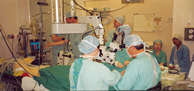
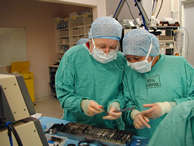
During the operation,
the surgeon is assisted either by another ophthalmologist or by the
specialist ocular oncology nurse.
A scrub nurse,
also wearing sterile gloves and gown, looks after the instrument trolley,
passing instruments as necessary to the surgeon and the assistant.
A 'runner' is also
present in the theatre in case any items need to be transferred to and
from the instrument trolley, to collect any tumour specimens and to
ensure that everything runs smoothly.
The ODA is at hand
to help with the operating microscope, operating lights, video recorder
and any other equipment.
There may occasionally
be visitors, such as ophthalmologists from other hospitals or medical
students.
The Recovery
Room
At the end of your operation, you will be transferred back to your own
bed and taken to the recovery room, where you will be monitored by your
own nurse (ie, one nurse per patient). The anaesthetist will also be
present until you regain consciousness.
The Ward
Once you have recovered from the anaesthetic and are comfortable, two
porters and a nurse will take you back to your ward.
In the ward, a
nurse will look after you and will give you any medications that you
require for the relief of pain or nausea.
After some types
of surgery (eg, endoresection and local resection), it may be necessary
for you to remain postured for the first day, for example, lying on
your left side with your left cheek against the pillow. This is so that
any retinal haemorrhage will gravitate away from your fovea and not
damage your central vision.
The Post-operative
Ward Round
Once a day, and more often if necessary, an ophthalmologist will examine
your eye. This is mostly to ensure that there is no infection and to
check that the intraocular pressure is normal.
Routinely, all patients
are examined first by a senior house officer or specialist registrar
between 8.15 am and 8.45 am, and then by the consultant between 8.45
am and 9.00 am. Please be sure to stay by your bed between these times.
Drops will be given
to you to keep your pupil dilated. This is to prevent discomfort and
to enable the back of your eye to be examined. Antibiotic and steroid
drops will also be given to prevent infection and inflammation.
If you have a radioactive
plaque in place, special precautions are necessary to prevent persons
around you from being exposed to unnecessary radiation. These include:
Do not be alarmed
by all these precautions. The amount of radiation is quite minimal.
Discharge from
Hospital
You can expect to return home one or two days after your operation.
When the time comes
for you to be discharged from hospital, you will be given a supply of
any drops and oral medications that are required. These will need to
be obtained from the hospital pharmacy. We order these medications a
few days in advance so that you will not be kept waiting when it is
time for you to return home.
You will also be
given a note to take to your General Practitioner.
Please ask the ward
nurse for a 'Sick Note' if you need one. If possible, the ward clerkess
will arrange an appointment for you at your hospital and will inform
you of the date and time before your discharge from the ward. If this
is not possible, then our secretary will ask your hospital to send you
an appointment by post.
The consultant will
send your ophthalmologist and general practitioner a discharge letter
with all relevant information about your condition. This letter is usually
dictated in the operating theatre at the end of your operation so that
it can be typed and posted around the time you leave the hospital.
With your consent,
a copy of the letter is also sent to your optician.
As soon as the results
of any pathology studies are received, these are sent to your ophthalmologist
and general practitioner together with a covering letter explaining
the significance of the results and suggesting further management as
appropriate.
Convalescence
at Home
When you return home, you may feel surprisingly tired and you may even
feel a little 'low' for a few days. These feelings are quite normal,
bearing in mind the stress of the previous few weeks, the inactivity
in hospital, and having to cope with one or two general anaesthetics.
Your convalescence
is a time for peace, good food, gentle exercise and coming to terms
with things, taking advantage of whatever help is available from family,
friends and various care workers.
You can wash your
hair and take a shower or bath at any time as long as you are careful
to avoid water from splashing into your eye, at least for the first
four or five days. It should be safe to go for a walk and to resume
mild exercise after one or two days, but more strenuous activities such
as running should probably be postponed for one or two weeks, depending
on the operation.
Your operated eye
will probably be quite red and tender for the first week or two, but
should settle down, especially if you remember to take your medications
as instructed. Until healing occurs, you eye will be particularly sensitive
to irritants such as soapy water, chlorinated water in swimming pools,
and smoke.
Within two weeks
of your return home, you will receive a telephone call from our specialist
ocular oncology nurse in case you have any problems. If you have any
questions, however, you can ring her up at any time (Tel: 0151 706 3976).
If she is not available when you phone, please leave a message on the
answerphone and she will reply as soon as possible.